-
Post
- Focus Training Centre LLC &
Focus Management Consultancy - Al Salmein Golden Tower, Suite 602
- Electra Street, PO Box 322
- Abu Dhabi, United Arab Emirates


Missed deadlines, unclear roles, and mismanaged budgets hold back promising careers in fast-growing companies every single day. Project management courses in the UAE give working professionals a practical framework for turning chaotic daily tasks into predictable business wins.
Whether you manage small departmental projects now or plan to lead complex cross-functional teams later, formal planning education gives you the clarity and credibility to succeed. You gain practical tools for delivering steady results on schedule, and that speeds up your long-term career growth.
Businesses across the Emirates are growing fast in construction, technology, energy, and finance. Employers no longer want people who only finish their daily tasks, because they are looking for leaders who can plan budgets, run cross-functional teams, and deliver on time. Project management courses provide the overall skills needed to manage the work.
Global demand is rising quickly too. According to the report, the world will need up to 29.8 million new project professionals by 2035 to keep up with economic growth and industry change. Building formal planning skills now puts you well ahead of that hiring wave.
Plenty of professionals inherit project duties without any formal instruction, so they end up guessing when timelines slip or stakeholders clash. Structured project management training UAE replaces that trial and error with repeatable, proven methods.
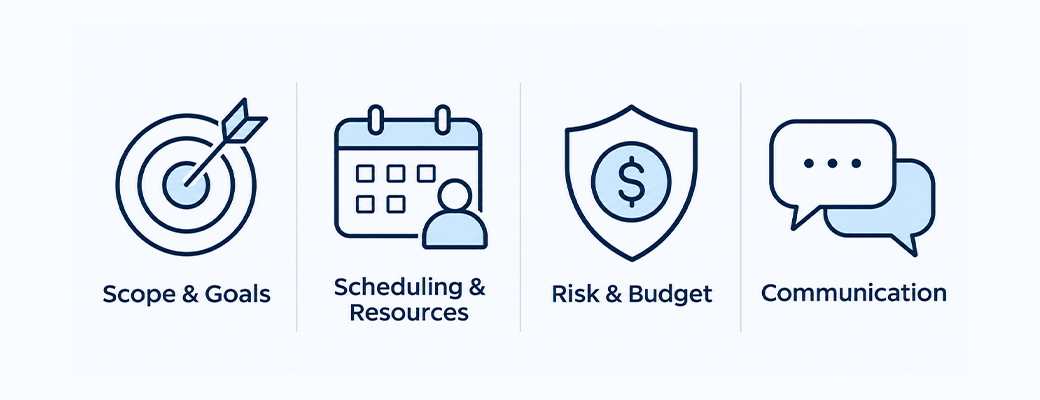
A good workshop walks you through every stage of a project, step by step:
Initiation and Scope: Start by agreeing on what the project must achieve and where its limits sit. A well-defined scope means a last-minute request will not knock your timeline sideways.
Scheduling and Resource Allocation: Intricate deliverables get easier once you cut them into small tasks and assign clear ownership. Add a Gantt chart, and your schedule starts to look convincing.
Risk and Budget Control: Most bottlenecks show up early if you go looking for them. Plan a fallback for the likely ones, and check your spending against the budget as you go.
Stakeholder Communication: Keep status meetings short and honest about progress. Executives and team members then hear the same story from kickoff right through to handover.
Few workplaces stick to one rigid workflow today, and good project leaders change their planning style to suit each assignment. Knowing when to use which method gives you a real edge, both in job interviews and in daily work.
Waterfall works well when a project has fixed requirements and a clear order of phases. Think of a construction upgrade, a compliance rollout, or a hardware installation, where each step depends on the one before it. The whole timeline gets mapped out on day one. After that, the team closes one milestone and only then picks up the next.
Agile frameworks work best when customer needs or market conditions change fast. Software development, digital marketing campaigns, and product launches all gain from short work cycles called sprints. Teams try out ideas early, collect feedback frequently, and shift their priorities before months of effort go to waste.
Many regional companies now prefer a Hybrid approach that mixes the two. Executives get the steady budget and milestone tracking of Waterfall, while delivery teams keep the day-to-day flexibility of Agile. If you learn all three styles, you can lead almost any initiative in any department.
No single program suits everyone, so start with your experience and your goals. A new team lead usually needs the basics to keep daily work moving. Senior managers usually want a credential that is respected everywhere in the world.
|
Training Focus |
Ideal Audience |
Primary Career Outcome |
| Foundational Project Workshops | Supervisors, team leads, and new coordinators | Master core planning, budgeting, and task execution frameworks |
| Certification Exam Preparation | Experienced managers with multi-year project hours | Qualify for senior leadership roles and higher salary brackets |
| Leadership and Result Delivery | Department heads and cross-functional managers | Align team output with broader organizational strategy |
Foundational workshops build confidence on the job straight away, while PMP training courses in the UAE get experienced practitioners ready for globally recognised certification. Our Delivering Results course is a useful addition too, as it helps managers clear obstacles and hit tough targets.

Even a well-planned project runs into roadblocks once the work starts. Team leads who lack training can struggle with scope creep, where clients or colleagues keep adding small requests, but the deadline never moves. Once you learn to document each change request, your team avoids burnout and your milestones stay realistic.
When departments share limited resources, friction between teams often slows the work down. A marketing coordinator may need design help just as the creative team is busy with another launch. Good training shows you how to weigh priorities fairly, flag delays early, and keep everyone working toward the same business goals.
Remote and hybrid teams spread across time zones need steady communication habits to stay on track. A fixed weekly check-in, a task board everyone can see, and a clear line on who makes the final call will clear up confusion early. That saves the team from doing the same work twice.
You do not need the title "Project Manager" to gain from structured planning. In fact, modern organisations run almost every major initiative as a project, so people in every department get a real advantage from knowing how projects work.
Here is how different roles use these frameworks every day:
Supervisors and Administrators: Step out of routine daily work and start leading department upgrades and process improvements.
Technical and IT Specialists: Turn complex engineering or software tasks into clear timelines that executives without a technical background can follow.
Operations and Procurement Staff: Line up vendor deliveries, keep a close eye on spending, and fix supply chain hiccups early, well before a client feels the impact.
Aspiring Team Leaders: Own your results and your mistakes, and you will show upper management that you can handle a bigger role.
A good professional course goes beyond theory, because you need instruction that reflects the problems you face at work. Before you sign up for project management courses in the UAE, it helps to weigh a few factors.
Start with the curriculum and see whether it includes hands-on exercises, case studies, and real planning tasks. Then look at the trainer's background and the class size, since experienced consultants bring lessons from actual projects that a textbook rarely captures.
The schedule matters just as much, and intensive three-to-five-day workshops let busy professionals build useful skills without spending months away from their desks.
Last, pick a provider that gives you room to grow, because project management training in the UAE paired with leadership coaching lets your growth continue long after the workshop is over.
Career growth rarely happens without a plan and some guidance, and that is where we come in. At Focus Training Centre LLC, experienced consultants lead practical leadership, management, and technical courses that help professionals across the region build skills for the long run.
Leading a high-stakes project for the first time is nerve-racking, but structured training, including PMP training courses in the UAE, builds real confidence.
Take a look at our Project Management workshop today, and start building your career with project management courses in the UAE that are designed around real workplace results.
An accredited corporate provider runs our interactive workshops in Abu Dhabi, and the training is hands-on and built around regional business standards.
No, you can start with no background at all. Introductory workshops walk through the full project lifecycle from the very beginning, which suits supervisors, coordinators, and new team leads well.
Our intensive workshops usually run two to five days. That lets busy professionals pick up useful skills without throwing their work routine off track.
Anyone who already leads a team across departments and wants a bigger role should consider it. Project coordinators and managers with some real experience get the most from PMP preparation, because the certification is often what separates them from a senior post.
Training changes how you handle a normal workday. Instead of guessing, you plan your schedule properly, spot risks before they grow, and keep stakeholders informed. Your projects then finish on time and stay within budget.