-
Post
- Focus Training Centre LLC &
Focus Management Consultancy - Al Salmein Golden Tower, Suite 602
- Electra Street, PO Box 322
- Abu Dhabi, United Arab Emirates


An employee can be very good at their job and still struggle to talk about it. Explaining an idea, writing a clear email, or speaking up in a meeting does not come easily to everyone. Delays follow, and so does confusion. Good opportunities slip away. This is where corporate English training Dubai gives your team the language skills for professional conversations. Employees learn to share information and work smoothly with others.
Across the UAE, English is the common language of business. Your employees talk to international clients, colleagues, suppliers, and partners daily. Each conversation requires them to be clear, whatever the situation
Basic English sometimes falls short. Employees have to follow business discussions and understand instructions. They also write professional documents and answer questions on the spot.
Consider what happens without these skills. An unclear instruction can slow a whole project. A poorly written email can confuse two departments. Employees who hesitate in meetings may never share an idea that could have helped.
Regular, structured practice makes a real difference. Employees build their speaking, listening, reading, and writing abilities over time. Managing workplace conversations then feels far less difficult. They also add more value to the team’s goals.
General English lessons rarely cover real office situations. Business communication needs suitable vocabulary and clear expression. It also needs an understanding of what the workplace expects.
Business English training Dubai focuses on the language your people actually use at work. Colleagues, customers, managers, and business partners all become easier to talk to.
Four areas deserve your attention:

Every day, employees have to describe tasks, report progress, and speak up in meetings. That is not always easy. Training shows them how to organize their thinking and share ideas in plain, clear language.
Ask a quiet employee to explain a problem in English, and you will see the hesitation. Regular speaking practice wears it down. Soon they suggest solutions themselves and take part in team conversations, not just sit through them.
Good professional writing is clear, grammatically correct, and suitably toned. Employees should know how to prepare emails, reports, proposals, and other business documents.
Take the email. It should state its purpose without padding. The reader should also find everything needed to take action.
Focused training makes a clear difference to writing. Our Business Writing course covers sentence structure, vocabulary, document organization, and professional writing techniques. Employees learn to write with more clarity.
Plenty of mistakes begin with poor listening. Communication is not only about speaking well. It means following instructions, noticing key details, and replying in the right way.
Most workplace mistakes start small. Someone misses an instruction, or half-hears a request in a meeting. Our Interdepartmental Communication course teaches active listening, along with information sharing and collaboration between teams.
Hesitation is easy to spot, and so is confidence. Presenting ideas or serving customers demands plain explanations and straight answers to questions. Employees also need to adjust their language to the audience.
Presentation practice helps employees organize a message and stress the key points. They also learn to handle questions without losing focus.
An effective program deals with the communication challenges your employees really face. Knowing the rules does not make someone a confident speaker. Therefore, language knowledge should be paired with practical workplace activities.
The table below shows the main learning areas:
|
Training area |
Skills developed |
Workplace application |
| Speaking | Fluency and clear expression | Meetings and discussions |
| Listening | Understanding and responding | Instructions and client calls |
| Writing | Grammar, structure, and tone | Emails and reports |
| Reading | Understanding business documents | Policies and proposals |
| Vocabulary | Professional terminology | Workplace conversations |
| Presentations | Organization and confidence | Client pitches and briefings |
Match these skills to your employees’ current abilities and job roles. Speaking and listening practice usually matters most for customer service teams. Administrative employees, meanwhile, may gain more from stronger writing and reading.
One weak link in communication can slow an entire team. Few workplace skills reach as far as English. International collaboration, professional development, and daily operations all depend on it. It also helps employees work with digital tools and global teams.
A March 2026 report from ETS points to this growing importance. Its Global English Skills Report surveyed more than 1,300 HR decision-makers across 17 countries.
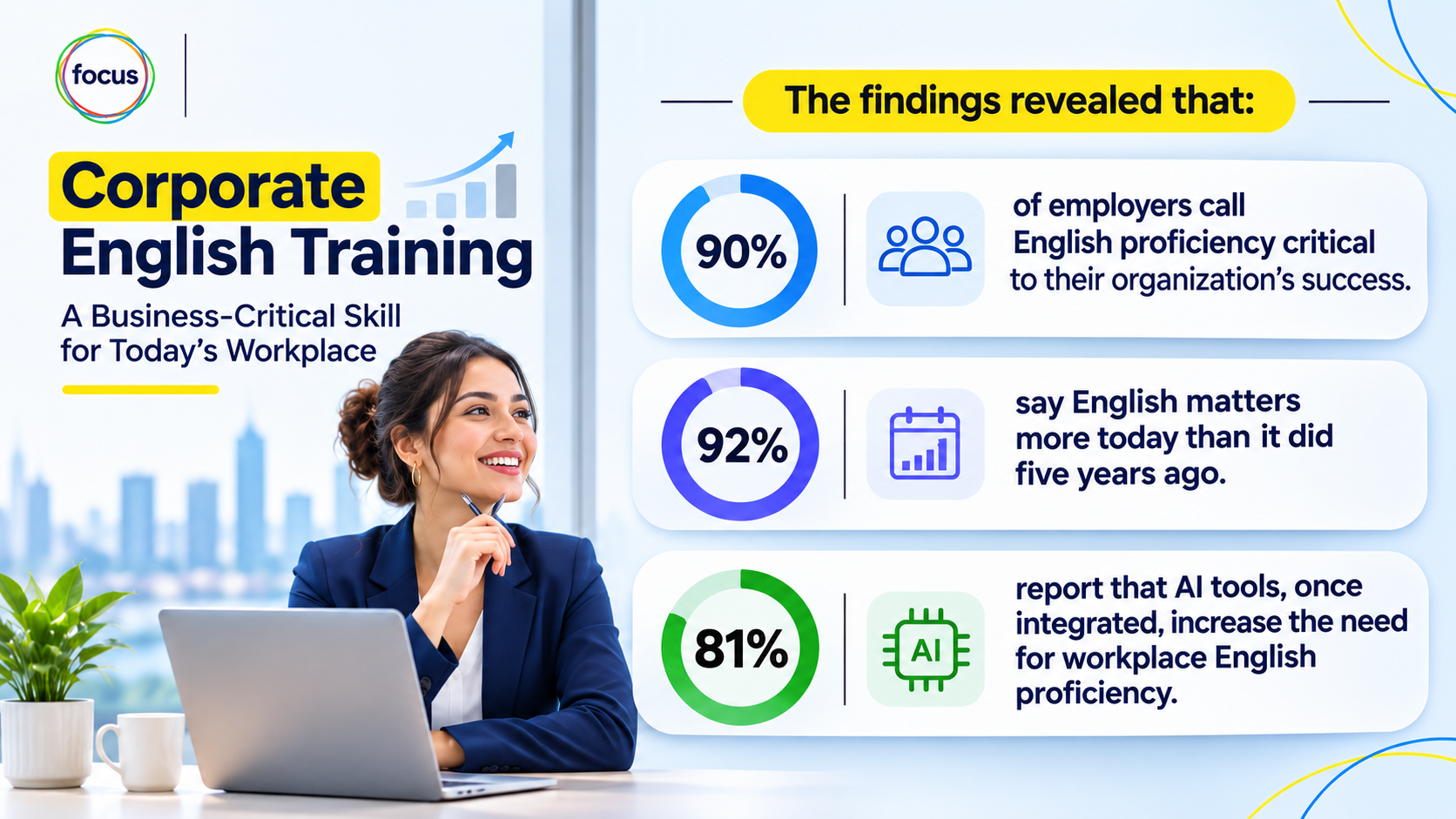
The findings revealed that:
90% of employers call English proficiency critical to their organization’s success.
92% say English matters more today than it did five years ago.
81% report that AI tools, once integrated, increase the need for workplace English proficiency.
The figures are hard to ignore. Language development deserves a place in your workforce plans, because employees must communicate with people, understand information, and use technology well.
English communication skills training should therefore cover more than pronunciation and sentence formation. Your team should be ready to communicate clearly in any workplace situation.
No two organizations communicate in the same way. A sales team may need stronger client conversations. Managers might want better presentation and negotiation skills.
Consider these factors before you select a program:
You cannot fix a problem you have not found. Language assessments, employee feedback, and workplace observation all give useful clues. Generic lessons waste everyone’s time. A well-planned corporate English training Dubai program should address these gaps and focus on the skills employees use every day.
Look at speaking, writing, following instructions, and meeting participation. Each shows a different learning need. Together, they help you set clear training priorities.
Generic training rarely survives a real workday. Customer-facing teams need polite language, clear explanations, and active listening.
Managers, however, work under different pressures. Presentations, professional discussions, and giving feedback matter more in their roles. Learning sticks when it connects to the daily job.
Knowing who needs what is half the job. A single large group rarely works, because English levels differ from person to person.
Test current abilities first, then sort training by level. Beginners build the essential language skills. Experienced employees refine how they communicate at work.
Knowing a skill and using it are two different things. Good programs close that gap with role-plays, group discussions, mock meetings, writing exercises, and presentations.
Practice only works when it feels real. Each activity mirrors a workplace situation, so trainers can see where individuals struggle and give useful feedback on the spot.
Results should be visible. Compare employees’ communication before and after the program.
Email quality is a good place to start. Meeting participation, presentation confidence, and the ability to understand instructions tell you a lot too. Regular feedback then points to the next learning need.
Looking for other options? Public training courses let you compare different professional development choices.
Formal training gives a strong start. Employees still need regular chances to use their skills afterward.
A few simple workplace practices help:
Hold short English discussions. Ten minutes at the start of the day is enough. Let teams talk through tasks and project updates in English.
Practice professional writing. Have employees draft sample emails, reports, and meeting summaries. Review them together afterward.
Encourage questions. Fear of looking unprepared keeps people quiet. Show them that asking for clarification is simply how good work gets done.
Arrange mock meetings. Employees rehearse sharing updates, discussing problems, and suggesting solutions. Mistakes here cost nothing.
Build workplace vocabulary. Teach the words and phrases each job actually uses, not a generic list.
Provide regular feedback. Say what is improving. Then show how to communicate more clearly.
It starts with the manager. Clear explanations and respectful conversations set the tone. Constructive feedback then makes speaking up feel safe for everyone.
Good communication changes how a workplace runs. Teamwork improves. Operations move faster. Business relationships get stronger. Employees still need the right guidance and regular practice to build these abilities.
For more than two decades, Focus Training Centre LLC has worked with organizations to grow their people. We shape each program around what you need. Our catalog now holds over 150 professional and business skills courses.
Corporate English training Dubai is a smart investment. Employees communicate confidently, handle their responsibilities better, and support long-term business growth.
Just about everyone who communicates at work. Employees, managers, and customer service teams all notice the change. Professionals who deal with international clients notice it first.
Every group is different, so the duration changes. Proficiency level comes first. Learning goals and the skills covered decide the rest.
Yes, and a tailored program wins every time. One built for the department works far better than a generic one. It can target customer conversations, presentations, professional writing, and more.
Professional vocabulary, email etiquette, meetings, presentations, and workplace discussions all find a place. Each topic mirrors a task employees face every single day.
Nothing replaces practice. Regular speaking, reading, and writing exercises help employees put new skills to work. Feedback along the way sharpens the results.