-
Post
- Focus Training Centre LLC &
Focus Management Consultancy - Al Salmein Golden Tower, Suite 602
- Electra Street, PO Box 322
- Abu Dhabi, United Arab Emirates


Many growing companies across the UAE hit a hidden wall when they scale. Teams work hard every single day. Still, missed deadlines and communication gaps slowly eat into overall profit margins. Business Skills Training Dubai closes that gap by giving staff practical workplace habits they can use at once. Trial and error costs time and money. Therefore, structured learning works better. It helps average contributors grow into confident, proactive problem solvers. Once employees master core operational skills, retention improves, and workflows run more smoothly. Measurable commercial growth follows soon after.
Fast-moving markets ask for much more than a technical degree or an impressive job title. Dubai offices are multicultural, and clear collaboration drives every project. Skip regular skill upgrades and even seasoned staff will fall behind. Client demands shift quickly. Digital tools change even faster. Replacing underperforming teams with outside hires is no fix either. It drains recruitment budgets and eats up management time.
Upskilling current staff fixes the problem from within. Structured corporate business skills courses teach employees to manage priorities, negotiate with vendors, and run meetings that span several departments. The lessons stick because people use them the very next day. Managers then spend far less time micromanaging daily tasks. Strategy gets their attention instead. Staff also feel truly valued when their employer invests directly in their career progression.
Good workplace education targets the daily behaviours that affect revenue and client satisfaction. Abstract theory has little place here. Practical workshops focus on what people can apply at their desks the same day. Below are the primary pillars that strengthen modern UAE teams:
Misunderstandings between departments usually delay key deliverables. Practical workshops on business writing and active listening change that. Staff learn to share concise updates and write persuasive proposals. They also handle tough client calls with a calm head. Swapping a confusing three-page report for a sharp executive summary saves senior leaders hours every week.
Some staff work hard yet never see the link between their decisions and company profitability. Targeted business acumen training fills that gap. It shows teams how budgets, revenue, and customer value tie together in each department. Take a procurement officer. A cheap supplier deal looks great until unreliable shipping starts costing more.
Stepping from a specialist role into management demands a completely new toolkit. Dedicated leadership and management pathways teach new supervisors to delegate well, settle team friction, and build accountability. A newly promoted IT team lead can stop fixing every bug personally. Coaching junior developers through complex sprints becomes the new job.
Keeping a loyal client costs far less than winning a new one. Programmes like understanding customer needs show front-line staff how to anticipate buyer expectations and earn lasting trust. One simple habit can save a lot of trouble. Confirm delivery timelines proactively, and costly complaints rarely get the chance to escalate.
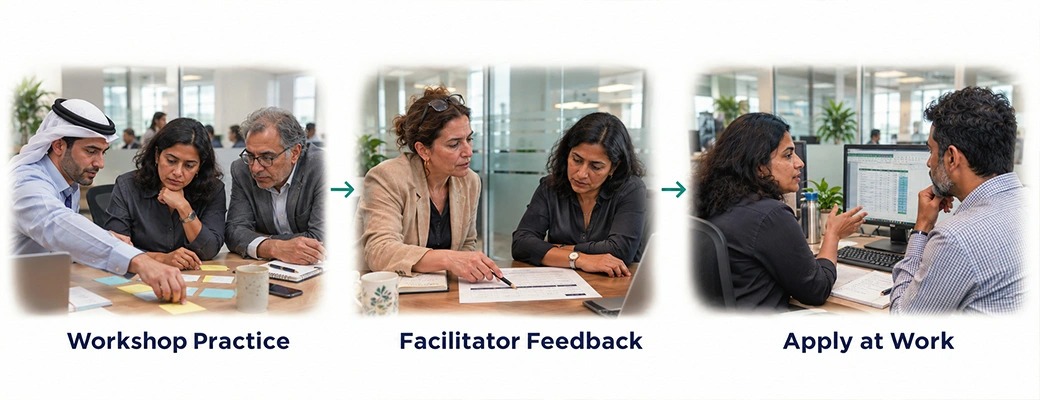 Every major sector across the region is growing, and the workforce is growing with it. A November 2026 Gulf Newsworkforce report records a 104 percent jump in UAE workers. Skilled professionals rose by 50 percent. Yet the competition for strong talent has never been fiercer. Relying solely on outside hiring leaves capability gaps wide open.
Smart employers therefore put employee skills development training first. It keeps internal teams sharp and competitive. When learning programmes follow national economic shifts, employees adapt faster to automation, data-driven decisions, and hybrid work. Continuous Business skills training Dubai also gives local and expatriate teams one shared standard of excellence.
Many organisations assume junior staff will simply pick up professional habits by watching seniors. Sometimes that works. Sometimes, though, observation hands down outdated habits along with the useful shortcuts. The table below shows where structured workshops beat casual workplace learning:
|
Key Factor |
Informal On-the-Job Learning |
Structured Corporate Training |
| Skill Consistency | Varies heavily depending on who mentors the employee | Standardizes best practices across every department |
| Speed of Mastery | Slow progress through costly trial and error | Fast adoption using guided exercises and case studies |
| Measurable Outcomes | Hard to track behavior changes or return on investment | Clear assessments, KPIs, and post-course evaluations |
| Employee Engagement | Generally feels reactive and overwhelming during busy weeks | Builds confidence through dedicated, supportive coaching |
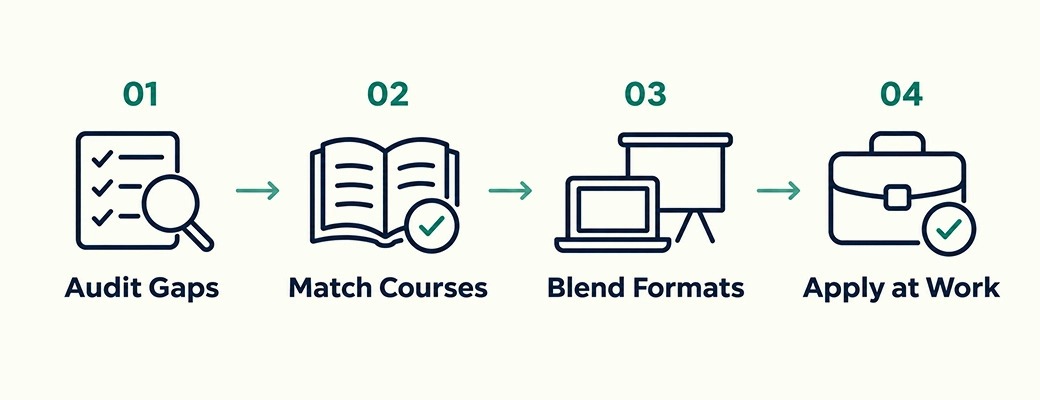
Successful learning does not happen by accident. It takes careful planning, not a scattered list of workshops. Employees tune out when training feels disconnected from their jobs. Here are the steps that build a programme with lasting impact:
Review recent project bottlenecks, client feedback and performance appraisals. Find out whether the team struggles most with time management, conflict resolution or commercial negotiation.
Never push everyone into identical sessions. Enrol technical specialists in delivering results workshops, and place emerging supervisors on accredited leadership tracks.
Few managers can free up every team member at the same time. Blending live interactive workshops with online training removes the problem. Staff learn on a flexible schedule, and daily operations keep running smoothly.
Lasting change does not happen in the training room. It happens back at the desk. Line managers can help by giving participants real projects that put the new frameworks to work immediately.
Follow this approach, and Business skills training Dubai stops being a yearly HR cost. It becomes a measurable profit driver. Staff value clear milestones as well. Each lesson connects to a possible promotion, and that matters to them.
Workshops fail when they ignore the local market. Pick a provider who understands how business works in the Gulf, not one who simply imports a foreign template. Strong facilitators bring regional knowledge and global standards together. Add customised case studies, interactive role-plays and post-training assessments, and a dull seminar becomes real workplace transformation.
Startup or established enterprise, the result is the same. Corporate business skills courses strengthen every layer of your organization. Consistent employee skills development training does more, too. It shields your business from sudden market disruption and lifts morale in every department.
Lasting business success rests on the daily capabilities of your people. Commit to Business Skills Training Dubai and your workforce learns to communicate clearly, solve complex problems, and lead with confidence.
We at Focus Training Centre LLC provide learning, development and HR solutions across the UAE and the wider Middle East. Our practical programmes span leadership, soft skills, and technical competencies.
We partner with your business to unlock talent. Together, we build teams that perform at a high level.
Proven frameworks take the place of guesswork. Time management, clear communication and problem-solving all improve. Tasks get done sooner, and fewer costly mistakes slip through.
All departments gain something. Newly promoted supervisors learn to delegate. Client-facing teams get better at negotiation and service etiquette.
Yes. Tailored workshops draw on real company scenarios, regional case studies, and exercises built for each role. Lessons then fit straight into daily work.
Options start with a single intensive day. They stretch to multi-week modular academies. The right fit depends on your team’s schedule and goals.
Numbers show whether training worked. Managers record KPIs at the start and at the end. Project turnaround, client satisfaction scores, internal promotions, and staff retention all tell the story.